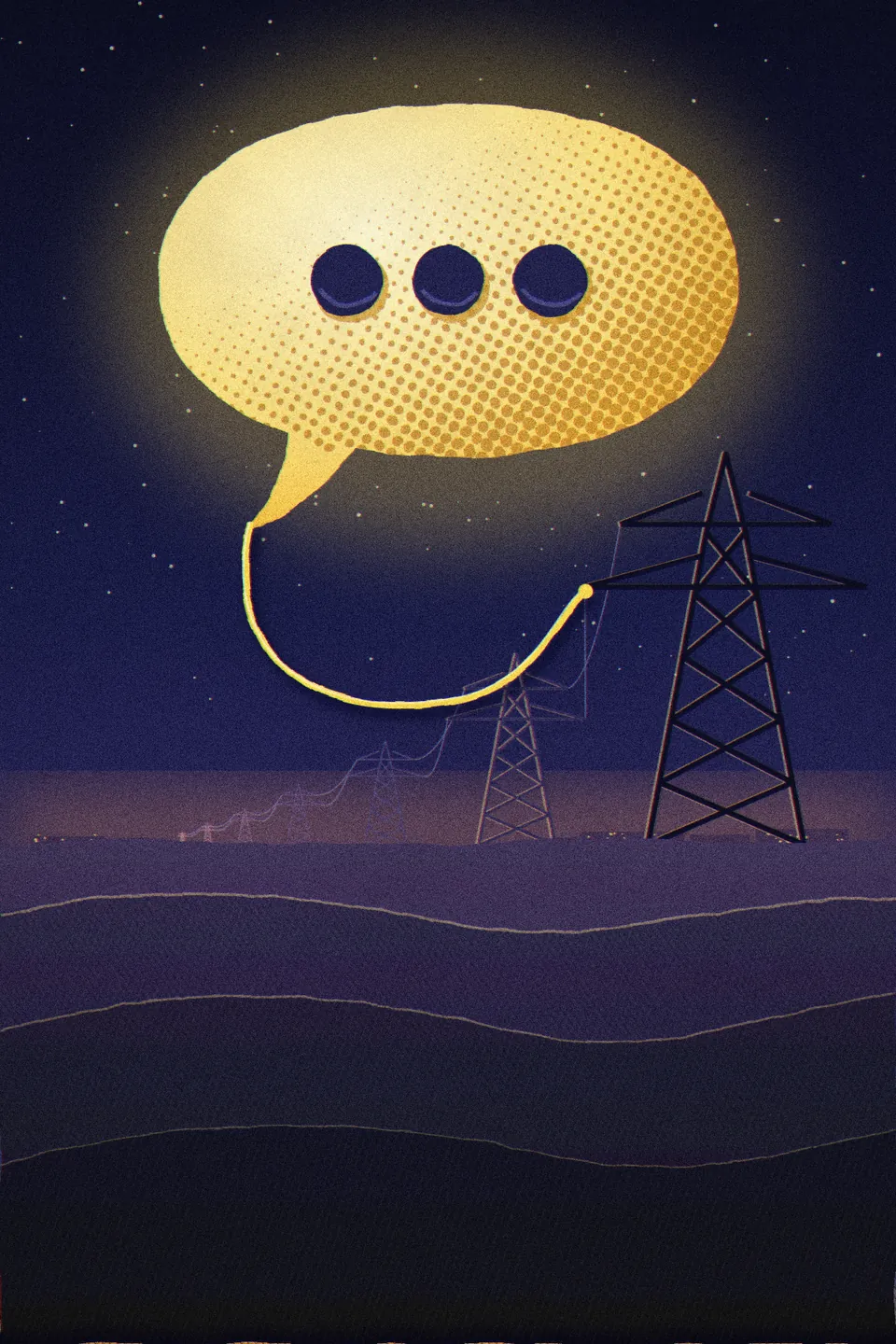
When you ask an AI model a question, it feels like nothing happened. You type, it answers, the phone stays cool in your hand. The whole thing seems to live in some weightless place called the cloud.
There is nothing weightless about it.
Somewhere, possibly thousands of kilometres away, your question landed in a building full of specialised chips. Those chips drew power from a grid, turned almost all of it into heat, and needed pumps, fans or water to carry that heat away. The building sits on land that someone had to buy, permit and connect. Your answer was a small industrial event.
Multiply that by billions of questions a day, plus the enormous runs used to train the models in the first place, and you arrive at the least glamorous and most important fact about artificial intelligence. It runs on electricity, and electricity runs on infrastructure.
Software that behaves like steel
For most of the history of the internet, software had a magical economic property. Once you built it, serving one more user cost almost nothing. A search engine or a social app could grow by orders of magnitude without its costs growing nearly as fast.
Large AI models break that pattern. Every response requires real computation on expensive hardware, and the more capable the model, the more computation each answer tends to need. Growth in usage turns directly into growth in chips, buildings and power.
That makes the frontier of AI look less like a typical software business and more like heavy industry. The leading companies now talk openly about building data centres measured not in servers but in gigawatts. A gigawatt is roughly the output of a large nuclear reactor. A single AI campus planned at that scale wants the electricity of a small city, all day, every day.
So the conversation has shifted. A few years ago the question was who had the best researchers. That still matters enormously. But a second question now sits next to it: who can actually plug the machines in?
The four bottlenecks
If you want to understand the physical side of AI, it helps to look at four constraints. Any one of them can stall a project.
Power
The obvious one. AI data centres need large amounts of electricity, and they need it reliably. A chip cluster that costs billions cannot sit idle because the grid had a bad afternoon.
The difficulty is that power is slow. A data centre building can go up in a year or two. A new power plant, or the high-voltage lines to connect it, can take much longer, often held up by planning, permits and equipment. In many places, the wait to connect a large new user to the grid has become one of the main limits on how fast AI can grow.
That is why technology companies, which used to think of electricity as a utility bill, have started acting like energy companies. In 2024, Microsoft signed a long-term deal intended to bring back a reactor at Three Mile Island in Pennsylvania, a site most people remembered only for the 1979 accident at its other unit. When software companies start reviving nuclear plants, you know the ground has moved.
Chips
The second bottleneck is the silicon itself. The most advanced AI chips are designed by a handful of companies, with Nvidia far in the lead, and the most advanced manufacturing is concentrated in very few places, above all TSMC in Taiwan.
These chips are among the most complex objects humans have ever made, and the factories that produce them cost tens of billions of dollars and take years to build. Supply has repeatedly lagged behind demand. Governments now treat access to these chips as a matter of national strategy, with export rules deciding who can buy the best ones.
Cooling
Almost every watt that goes into a chip comes out as heat. Pack thousands of powerful chips into one building and you have built a very expensive heater.
Older data centres mostly cooled equipment with air. The newest AI hardware runs so hot that the industry is moving toward liquid cooling, piping fluid directly to the chips. Many facilities also use water to help reject heat, which creates real tension in dry regions where water is precious.
Cooling also eats energy of its own. The more efficient the cooling, the more of the electricity actually goes into thinking rather than into keeping the building from overheating.
Land
The quietest bottleneck. Large AI campuses need space, and not just any space. They need land near strong grid connections and power sources, with permission to build, ideally far from neighbours who object to the noise and the transmission lines.
In crowded countries, finding all of that in one place is hard. In places with open land, abundant energy and governments willing to move quickly, it is much easier.
Training versus everyday use
There are two different energy stories inside AI, and it helps to separate them.
The first is training: the huge, concentrated effort of building a new model. It happens in large bursts, makes headlines, and requires enormous clusters running for long periods.
The second is everyday use, which engineers call inference. This is every question, every summary, every generated image, every coding assistant suggestion. Each one is tiny. Together they are vast, and unlike training, they never stop. As AI gets built into search, phones, offices and cars, inference becomes a permanent, growing load on the grid.
That is why efficiency gains matter so much, and also why they will not simply make the problem disappear. When AI gets cheaper to run, people find more things to use it for. The demand curve tends to grow into whatever capacity is built.
The brain runs on roughly the power of a dim light bulb. Our machines are not there yet, and the gap is measured in power stations.
It is worth remembering how efficient biology is. A human brain uses around twenty watts. That one fact should keep everyone humble about how far machine efficiency still has to go, and hopeful about how much room there is to improve.
Why the Gulf is suddenly central
Put the four bottlenecks next to a map and some regions start to look very different.
The Gulf has spent most of a century as one of the world's great energy exporters. The UAE and its neighbours have deep experience building large energy projects, plenty of land, strong state capacity to coordinate permits and infrastructure, and sovereign capital that can think in decades rather than quarters.
The energy mix is also changing in ways that matter for AI. Desert sunshine has made solar power in the region among the cheapest anywhere, and Abu Dhabi and Dubai have both built some of the world's largest solar parks. The UAE also operates the Barakah nuclear plant, whose four reactors now supply a significant share of the country's electricity around the clock. Firm, reliable power plus cheap solar is exactly the kind of combination an AI data centre wants.
Unsurprisingly, the region has moved fast. In 2025, the UAE announced plans with American technology partners for a very large AI campus in Abu Dhabi, planned on a scale measured in gigawatts. Saudi Arabia has announced its own major AI infrastructure ambitions. Whatever one thinks of individual projects, the direction is clear: the Gulf intends to be a place where intelligence is manufactured, not just consumed.
There are real challenges. Heat makes cooling harder and more expensive. Water is scarce, which pushes designs toward cooling methods that use less of it. Access to the most advanced chips depends on international agreements. None of these are small. But they are engineering and policy problems, and the region has a long track record of treating those as solvable.
What this means if you build
For founders and engineers, the physical side of AI is not just a story for governments and giant companies.
It means the cost of intelligence will be shaped partly by energy prices. It means the location of compute is becoming a strategic choice, with consequences for latency, regulation and data sovereignty. It means there are serious opportunities in the unglamorous layers: energy management, cooling, grid software, efficient models, and tools that do more with less compute.
And it means a useful habit: whenever someone describes an AI future, ask where the electricity comes from. It is a surprisingly good test of whether a plan is real.
The new oil field
For most of the twentieth century, the map of power followed the map of oil. Countries that sat on energy and knew how to use it gained an influence far beyond their size. The Gulf knows that story well, because it lived it.
The twenty-first century may draw a new map, one that overlays energy, chips and data centres. Intelligence is becoming something a country can produce, store and export, and the factories that produce it need power above all else.
The cloud was always a building. The building was always a power plant. The question for the coming decades is simple.
Who keeps the lights on for the machines that think?
Further reading
- Chip War — Chris Miller
- The Prize — Daniel Yergin
- How the World Really Works — Vaclav Smil