On a Friday in March 2016, in a courtroom in St. Petersburg, Florida, a jury handed down a number that ended a media company.
Gawker had published a short clip from a sex tape of the wrestler Hulk Hogan, whose real name is Terry Bollea. Bollea sued for invasion of privacy. On March 18 the jury awarded him 115 million dollars. Three days later it added 25 million in punitive damages, part of it assessed personally against Gawker's founder, Nick Denton. Roughly 140 million dollars, against a company that could never pay it.
Gawker said it would appeal. It looked like a celebrity case that had gone badly wrong for a gossip site.
Nobody in the room was talking about the man who had been paying for it.
Two months later, Forbes reported that the lawsuit had been quietly financed by a Silicon Valley billionaire. The next day he confirmed it to The New York Times. He had spent, by his own account, roughly 10 million dollars. He called it "one of my greater philanthropic things that I've done." He said it was "less about revenge and more about specific deterrence."
His name was Peter Thiel. And to understand why he did it, and why he waited so long, you have to understand how he thinks. Because the same mind that made him one of the most successful investors alive is the one that spent years hunting a publication.
The man who looks where nobody else is looking
Start with the genius, because it is real.
In December 1998, Thiel, Max Levchin and Luke Nosek founded a company called Confinity to move money between Palm Pilots. It merged with Elon Musk's X.com, became PayPal, went public in early 2002, and was bought by eBay that year in an all-stock deal valued at about 1.5 billion dollars. Thiel was its chief executive.
Then, in 2004, he wrote one of the most famous cheques in business history. He put 500,000 dollars into a college social network run by a 20-year-old named Mark Zuckerberg, for about 10.2 percent of it. When Facebook went public in 2012, Thiel sold most of his shares for more than a billion dollars.
He co-founded Palantir in 2003, a data analysis company built for intelligence agencies, with early money from In-Q-Tel, the venture arm that funds technology for the CIA. In 2011 he started paying brilliant teenagers 100,000 dollars over two years to leave college and build things. People laughed. Many of them built companies anyway.
In 2014 he and Blake Masters turned his Stanford lectures into Zero to One, which became the startup bible of the decade. It is a genuinely good book. Its central idea is simple and cold. Most people think competition is healthy. Thiel thinks competition is where profits go to die. The goal is to build something so different that you have no rivals at all: a monopoly. His essay for The Wall Street Journal that year carried a headline that founders still quote at each other: "Competition Is for Losers."
He also gave the world his favourite interview question: what important truth do very few people agree with you on?
I have built companies, and I still think that question is one of the best tools a founder can carry. It forces you to look where the crowd is not looking. That is Thiel's real gift. He is a contrarian who is often right, and that combination is rarer than either part alone.
But notice the shape of the philosophy. Competition is for losers. The crowd is wrong. The winner is the one who gets away from everyone else.
Keep that shape in mind. It shows up everywhere.
The essay
In April 2009, Thiel published an essay on Cato Unbound, a forum run by the libertarian Cato Institute. It was called "The Education of a Libertarian," and it contained a sentence that has followed him ever since.
"I no longer believe that freedom and democracy are compatible."
He explained why. "Since 1920, the vast increase in welfare beneficiaries and the extension of the franchise to women," he wrote, describing both as constituencies that are notoriously tough for libertarians, "have rendered the notion of 'capitalist democracy' into an oxymoron."
The backlash was immediate, and he published a clarification saying it would be absurd to suggest women's votes would be taken away. But the essay's real argument was not about voting. It was about leaving.
"In our time," he wrote, "the great task for libertarians is to find an escape from politics in all its forms." He named three escape routes. Cyberspace. Outer space. And the oceans: floating cities beyond the reach of any government.
That last one was not a metaphor. A year earlier, in April 2008, he had pledged 500,000 dollars to the newly founded Seasteading Institute, set up to design sovereign communities at sea. The essay ends with a line that sounds like a superhero film and reads, in hindsight, like a business plan: the fate of our world may depend on the effort of a single person who builds the machinery of freedom.
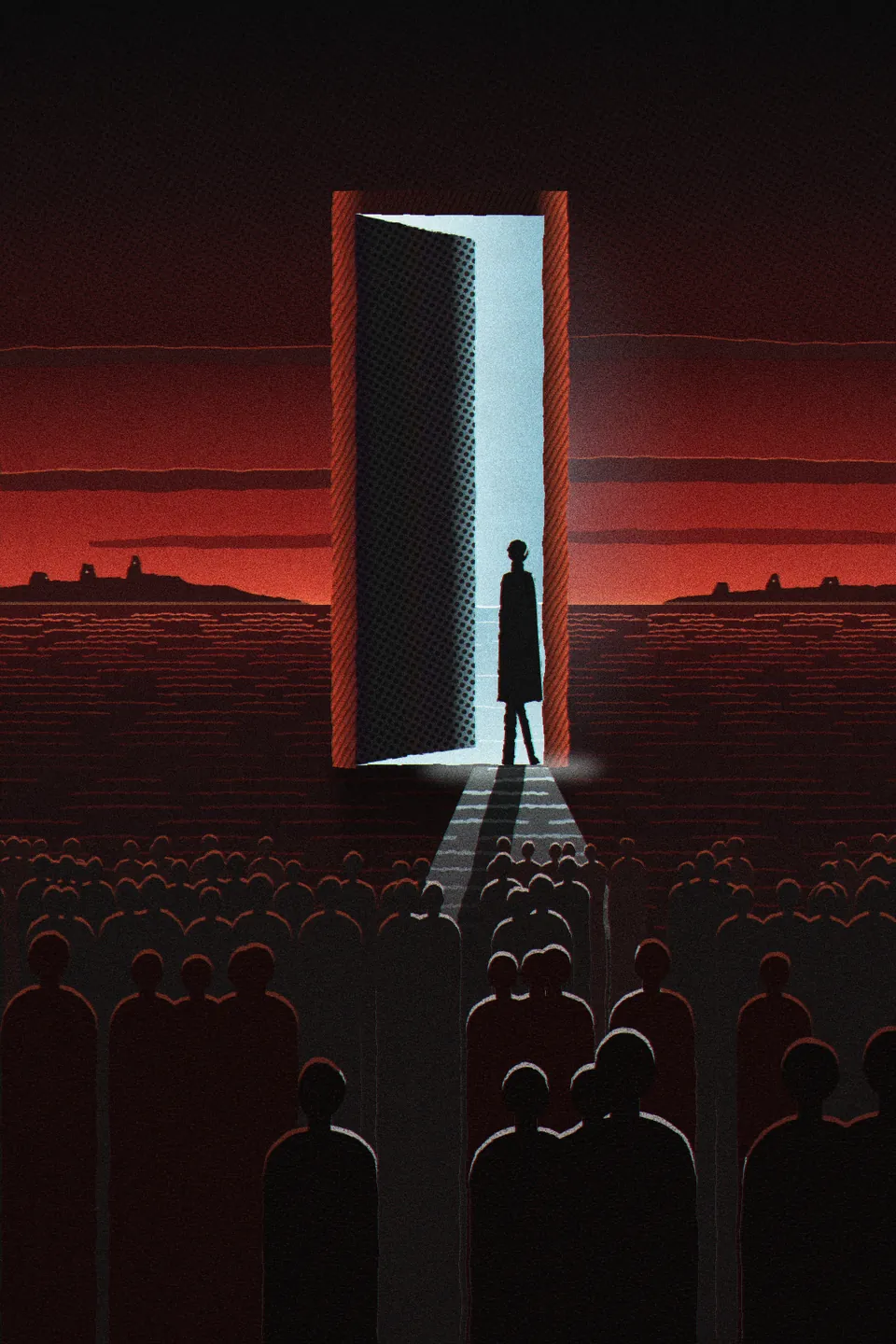
He did not want to win the argument with democracy. He wanted a door out of it.
Twelve days
In 2017, New Zealanders discovered that Peter Thiel was one of them.
He had been granted citizenship back in June 2011, at a private ceremony at the New Zealand consulate in Santa Monica. Nobody had been told. When the government was finally made to release the file, it showed he had spent 12 days in the country before he applied.
The normal rule asks permanent residents to spend the large majority of five years in New Zealand, well over 1,300 days, before applying. Thiel did not meet that test or the shorter alternative. His citizenship was approved by a minister under a clause for "exceptional circumstances," and the minister defended it by calling him a fantastic ambassador for the country.
He already held American and German citizenship. Now he had a third passport, from a remote island nation that wealthy people talk about as the place to go when everything else falls apart.
You do not have to believe anything sinister to see the pattern. The man who wrote about escaping politics had quietly built himself another exit.
The long patience
Now go back to Gawker.
In 2007, Gawker's Silicon Valley blog, Valleywag, ran a post with the headline "Peter Thiel is totally gay, people." Thiel had not chosen to come out publicly. In 2009, asked about Valleywag, he said its writers "should be described as terrorists, not as writers or reporters."
Then, for years, nothing visible happened.
What was happening, Thiel later explained, was that he had hired a legal team to look for people Gawker had harmed, people who in his words "would have accepted a pittance for a settlement" because they could not afford a long fight. He would fund them instead. Bollea was one. Thiel told the Times "it's safe to say this is not the only one." He also said he did not expect to make any money from it.
Here the honest version of the story gets complicated, and it should.
Gawker was not an innocent victim. A Florida jury heard the evidence and decided it had violated a man's privacy by publishing a recording of him having sex that he said was made without his knowledge. Many people who care about journalism thought Gawker was cruel and indefensible in that case. Thiel's lawsuit was legal. Litigation funding is legal. He broke no law.
And yet.
The jury did not know who was paying. The public did not know. A man with billions of dollars spent years searching for cases that could bankrupt a publication that had written about him, and he picked a fight he could finance indefinitely against a company that could not survive it.
Gawker Media filed for bankruptcy in June 2016. Its other sites were sold to Univision for 135 million dollars. Gawker.com stopped publishing that August. In November, the company settled with Bollea for 31 million dollars.
Thiel said it was about deterrence. He was right about that part. Every editor in America learned the same lesson that summer: you are not only writing about rich people, you are writing about people who can afford to wait.
The verdict was the jury's. The patience was his.
The kingmaker
Two months after the Gawker story broke, Thiel walked onto the stage at the Republican National Convention in Cleveland.
"I am proud to be gay," he told the crowd. "I am proud to be a Republican. But most of all I am proud to be an American." That October, The New York Times reported he would give 1.25 million dollars to support Donald Trump. After the election he joined the transition team. In a Silicon Valley that had overwhelmingly backed Clinton, he had made the contrarian bet, and it had paid.
He made an even bigger one in 2022.
JD Vance, author of Hillbilly Elegy, had worked at an investment firm Thiel co-founded and had backing from Thiel for his venture fund. When Vance ran for the Senate in Ohio, Thiel gave about 15 million dollars to a super PAC supporting him, which Politico reported as the largest amount ever given to boost a single Senate candidate. In Arizona he gave a matching 15 million or so to a super PAC behind Blake Masters, his co-author on Zero to One and the chief operating officer of his family office.
Masters lost in the general election. Vance won. Two years later, Vance became Vice President of the United States.
Pause on that. The man who wrote that he no longer believed freedom and democracy were compatible helped build, through elections and record donations, the career of the person now one heartbeat from the presidency. He did not escape politics in the end. He bought a seat close to the centre of it.
The Antichrist
In September 2025, Thiel gave four lectures at the Commonwealth Club in San Francisco. The topic was the Antichrist.
They were off the record, organised by a Christian technology group called the ACTS 17 Collective, and tickets sold out. The Washington Post later reviewed recordings. According to its reporting, Thiel argued that the Antichrist of the modern age might arrive as a world government promising peace and safety, and that the people pushing to slow or regulate science and technology were doing its work. Reports from the lectures said he named the climate activist Greta Thunberg and the AI critic Eliezer Yudkowsky as examples.
It is a fascinating set of ideas, drawing on the philosopher René Girard, whom Thiel studied with at Stanford. It is also hard not to notice what critics pointed out at once. The man warning that a total surveillance state might be the face of the Antichrist co-founded Palantir, a company whose whole business is helping governments see more of their people.
A few months earlier, in an interview for The New York Times, the columnist Ross Douthat asked him a simple question. "I think you would prefer the human race to endure, right?"
Thiel said: "Uh."
Then: "Well, I don't know. I would, I would."
"This is a long hesitation," Douthat said. Thiel said there were so many questions implicit in it. Douthat asked again whether the human race should survive. This time Thiel said yes, and added that he would also like us to radically solve our problems.
He was talking, he explained, about transhumanism, about changing what humans are. That is a serious philosophical position. But I keep coming back to the pause. For a few seconds, one of the most powerful investors on Earth could not give a straight answer to whether people like you and me should continue.
Every door is an exit
Look at the whole life at once and it has one shape.
He escaped competition by teaching founders to build monopolies. He tried to escape politics with floating cities and essays about new frontiers. He escaped geography with a passport from a country he had barely visited. He has funded research into escaping ageing and death. When a publication hurt him, he did not argue with it in public. He waited years and removed it.
The genius is real. Zero to One will still be read when most business books are pulp. His instinct for what the crowd has missed is as good as anyone's alive.
But there is a difference between thinking differently from the crowd and thinking you are owed a way out of it. Most of us do not get an exit. We live inside the democracy, the country, the body and the news cycle we were given, and we have to make them work.
Thiel's best question was always: what do you believe that almost nobody agrees with?
Here is the answer his life gives. That the rest of us are the problem to be escaped. And that with enough money, you can build the door, walk through it, and close it behind you.
Further reading
- Zero to One — Peter Thiel with Blake Masters
- The Contrarian — Max Chafkin
- Conspiracy — Ryan Holiday
- The Education of a Libertarian — Peter Thiel, Cato Unbound