The story goes like this. Early in the eleventh century, a scholar from Basra was summoned to Egypt by the Fatimid caliph al-Hakim, a ruler known for sudden and sometimes terrifying decisions. The scholar had boasted that the Nile's floods could be controlled with the right engineering. The caliph wanted it done.
So the scholar travelled south up the Nile to look at the problem with his own eyes. And he saw, with growing dread, that he had been wrong. The river was too big, the task impossible with anything he could build.
Telling al-Hakim he had failed seemed dangerous. So, according to the account preserved by later biographers, he did something strange. He pretended to be mad. He was confined to his house, and he stayed there, under a kind of arrest, for years, until the caliph died in 1021.
Whether every detail is true, nobody can now say for certain. But the man in the story is real, and what he did with those years is not in doubt. His name was Abu Ali al-Hasan ibn al-Haytham. Europeans would later call him Alhazen. And in that long, quiet confinement, tradition says, he worked on one of the most important science books ever written.
How do we see?
Ask someone today how vision works and they will tell you, without much thought, that light bounces off things and enters your eyes. It feels too obvious to have ever been a question.
It was not obvious at all. For more than a thousand years, some of the sharpest minds in history believed the opposite.
Euclid and Ptolemy, the great Greek mathematicians, worked with the idea that the eye sends out rays. Vision, in this picture, was a kind of reaching. Your eye throws out a cone of rays, and where they land, you see. It explained some things elegantly, like why you see things in a particular direction, and it fit beautiful geometry.
Other thinkers, following Aristotle in different ways, argued that something travels from the object to the eye instead. But nobody had combined that idea with rigorous geometry and proof.
Ibn al-Haytham did. In his Book of Optics, written in seven parts, he argued that we see because light from every point of an object travels in straight lines into the eye. Then he went further and worked out, in detail, how the geometry of those rays could form an orderly picture.
He used evidence anyone could check. Stare at the sun and your eyes hurt. Look at something very bright and then look away, and you still see its afterimage. If vision were only the eye reaching out, why would bright light do anything to the eye? Something was clearly coming in.
The dark room
The most famous experiments in the book take place in the dark.
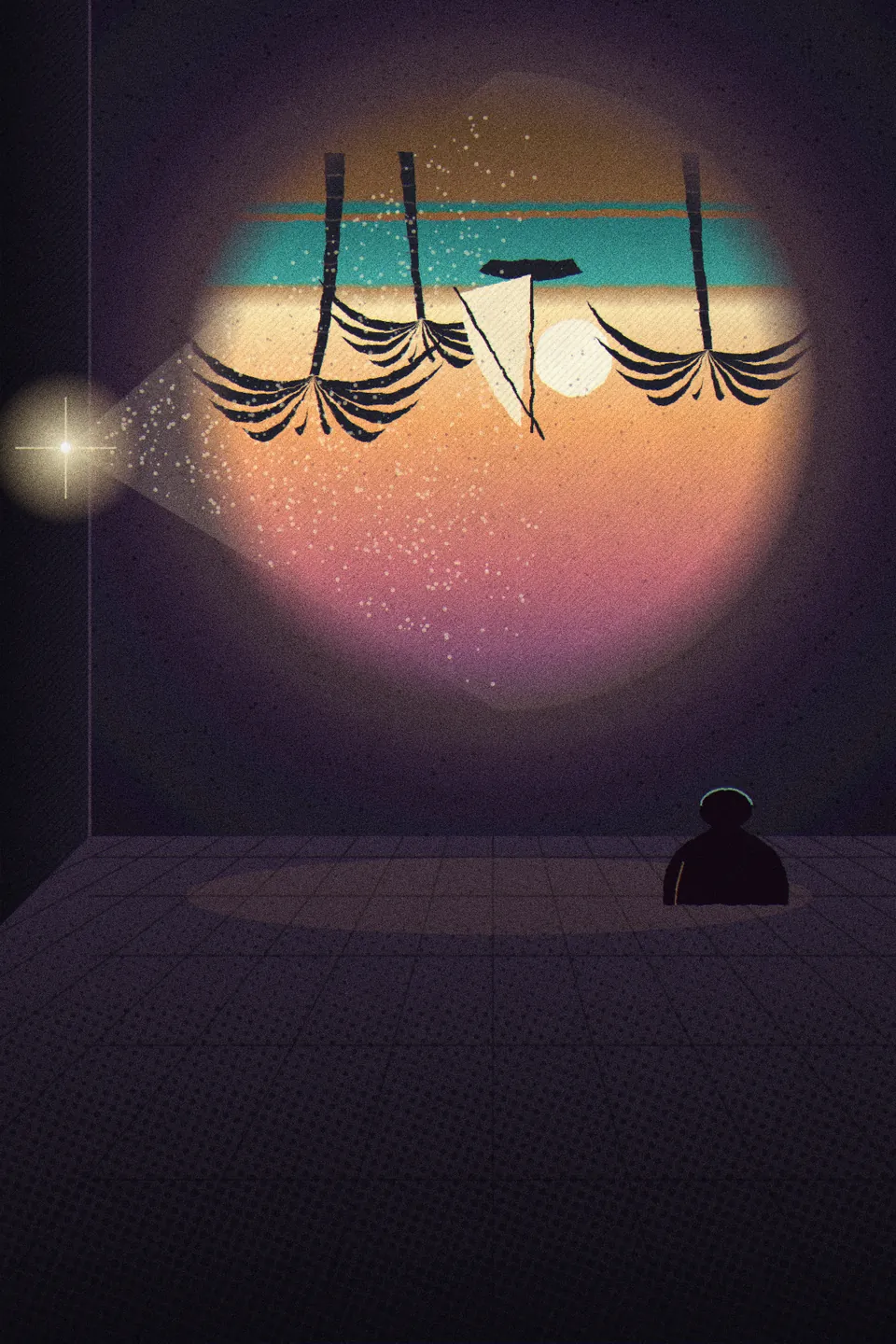
Imagine a room with no light except what comes through one small hole in the wall. Outside, set up several lamps at different spots. On the wall opposite the hole, you see a separate spot of light for each lamp, each one positioned on a straight line from its lamp through the hole.
Now cover one lamp. Its spot disappears. Only its spot. The others stay exactly where they were.
From this simple setup, Ibn al-Haytham drew powerful conclusions. Light travels in straight lines. Beams from different sources can pass through the same small opening at the same time without mixing or disturbing each other. And a small hole lets in an image of the world outside.
This dark chamber, later known by the Latin name camera obscura, would become one of the most important tools in the history of optics, and the distant ancestor of every camera.
What matters most, though, is not the device. It is the way he used it. He changed one thing at a time. He predicted what should happen. He watched what did. He repeated it. He described the setup so others could build it too.
Scholars who study his work point to a word he used for this kind of testing: i'tibar, a careful, controlled checking of claims against experience. Long before anyone wrote a textbook about the scientific method, he was practising a form of it.
An enemy of everything he read
If the dark room shows his method, another of his works shows his attitude.
It is called Doubts Concerning Ptolemy. Ptolemy was the towering authority on astronomy and optics, a name that had been treated with something close to reverence for centuries. Ibn al-Haytham read him closely and listed the places where his work contradicted itself or did not hold together.
In it, he set out a principle that still feels bold. Paraphrased, it goes like this: the person who studies the works of scientists, if truth is the goal, should make himself an enemy of everything he reads. He should attack it from every side. And he should suspect himself as well, so that he does not slip into either prejudice or leniency.
Notice that last part. It is easy to doubt other people. It is much harder to doubt yourself, your favourite theory, the conclusion you have already fallen in love with. Ibn al-Haytham asked for both.
He did not doubt for sport. He respected Ptolemy enough to read him more carefully than almost anyone had. Respect, for him, meant taking a work seriously enough to test it.
Respect, for him, meant taking a work seriously enough to test it.
A thousand-year shadow
Ibn al-Haytham wrote dozens of works, on mathematics, astronomy and more. But the Book of Optics had the longest reach.
Around the end of the twelfth century or the start of the thirteenth, it was translated into Latin. In Europe, it became a foundation text. Scholars like Roger Bacon and Witelo built on it. In 1572 it was printed in Basel alongside Witelo's work, putting it in the hands of a new generation of readers.
When Johannes Kepler published his own great work on optics in 1604, he presented it as a supplement to Witelo, the very author who had drawn so heavily on Ibn al-Haytham. The line of thought ran from a confined scholar in Cairo, through Latin translators and medieval scholars, into the scientific revolution.
He is often called the father of modern optics. Titles like that are always a little too neat. Science does not have single fathers; it is a long relay. The Greeks did real experiments, and many later scientists sharpened the method far beyond where he left it. But in the long relay, he ran an important leg, and he ran it with a clarity few people matched.
In 2015, the United Nations year dedicated to light celebrated a thousand years since his great work on optics. It was a fitting tribute to a man who was, in the most literal sense, trying to understand how we see anything at all.
Doubt as a daily habit
It is tempting to treat a figure like Ibn al-Haytham as a museum piece: a name to be proud of, a face for a stamp, a line in a list of golden-age achievements. That would miss what makes him useful today.
His real legacy is a habit. Do not believe something because a great name said it. Do not believe it because you have heard it many times. Set up a test. Change one thing. Watch what happens. Write it down so someone else can check you.
We live surrounded by confident claims. Influencers with a theory for everything, charts shared without sources, and now machines that can produce fluent explanations of anything in seconds, some true and some invented. Fluency is not evidence. Authority is not evidence. Repetition is certainly not evidence.
The tools for checking have never been cheaper. Most of us still rarely use them.
Ibn al-Haytham, according to the story, had to fake madness to buy himself the time to think. Then he spent that time in a dark room, watching small points of light, refusing to accept anything he could not test. You do not need to fake anything. You only need the nerve to be an enemy of what you read, starting with yourself.
Light still comes in through the small hole. The question is whether you are watching.
Further reading
- The Optics of Ibn al-Haytham — translated by A. I. Sabra
- Pathfinders: The Golden Age of Arabic Science — Jim Al-Khalili
- Ibn al-Haytham: First Scientist — Bradley Steffens