Somewhere around 1450, in the German city of Mainz, a former goldsmith named Johannes Gutenberg got a strange machine working.
It combined a few ideas that already existed. Screw presses had been squeezing grapes and olives for centuries. Ink and paper were not new. Movable type was not entirely new either: craftsmen in China had experimented with it centuries earlier, and in Korea a Buddhist text was printed with metal type in 1377. What Gutenberg added was a system. A hand mould that could cast thousands of identical metal letters quickly, an oil-based ink that stuck to metal, and a press adapted to push the two against paper evenly, again and again.
With twenty-odd letters in the Latin alphabet, the system worked beautifully. A page that took a scribe days to copy could now be reproduced hundreds of times.
It is one of the most consequential inventions in history. And the story of what happened next is stranger, and more useful, than the textbook version.
The inventor did not get rich
Gutenberg's great showpiece was a Bible, printed in the mid-1450s in a run of fewer than two hundred copies. It is still considered one of the most beautiful books ever made.
He did not get to enjoy it. Gutenberg had borrowed heavily from a financier named Johann Fust. In 1455, Fust sued him, and Gutenberg lost much of his equipment and work to Fust and to Peter Schöffer, who had worked in Gutenberg's shop. Fust and Schöffer went on to run a successful printing business. The man who invented the system spent his last years with far less to show for it.
That pattern repeated across the industry. Printing spread fast. By 1500, presses were operating in hundreds of towns across Europe and had produced millions of books. But many of the early printers went broke.
The reason is simple, and it is the first lesson of the press. Producing books turned out to be much easier than selling them. Printers overestimated demand, printed large runs of the same popular titles as their competitors, and ended up with warehouses full of unsold paper. The bottleneck had moved from making copies to finding readers, getting books to them, and convincing them a particular book was worth buying.
Producing books turned out to be much easier than selling them.
The first information overload
Before printing, books were rare and expensive. A scholar might own a handful. A great library might hold a few hundred manuscripts.
A century after Gutenberg, the problem had flipped. In 1545 the Swiss scholar Conrad Gessner published a huge catalogue of every book he could find, partly because he was alarmed by what he saw as a confusing and harmful abundance of them. Other scholars of the period made similar complaints. There were too many books, many of them bad, and no one could possibly read them all.
If that sounds familiar, it should. Every new medium that makes words cheaper triggers the same worry: that quality will drown in quantity, that people will read worse, that nobody will be able to tell what is true.
Those worries were not wrong. Printing did spread errors, forgeries, sensational pamphlets and propaganda at a speed manuscripts never could. But something else happened too.
People started building tools.
The real winners were the organisers
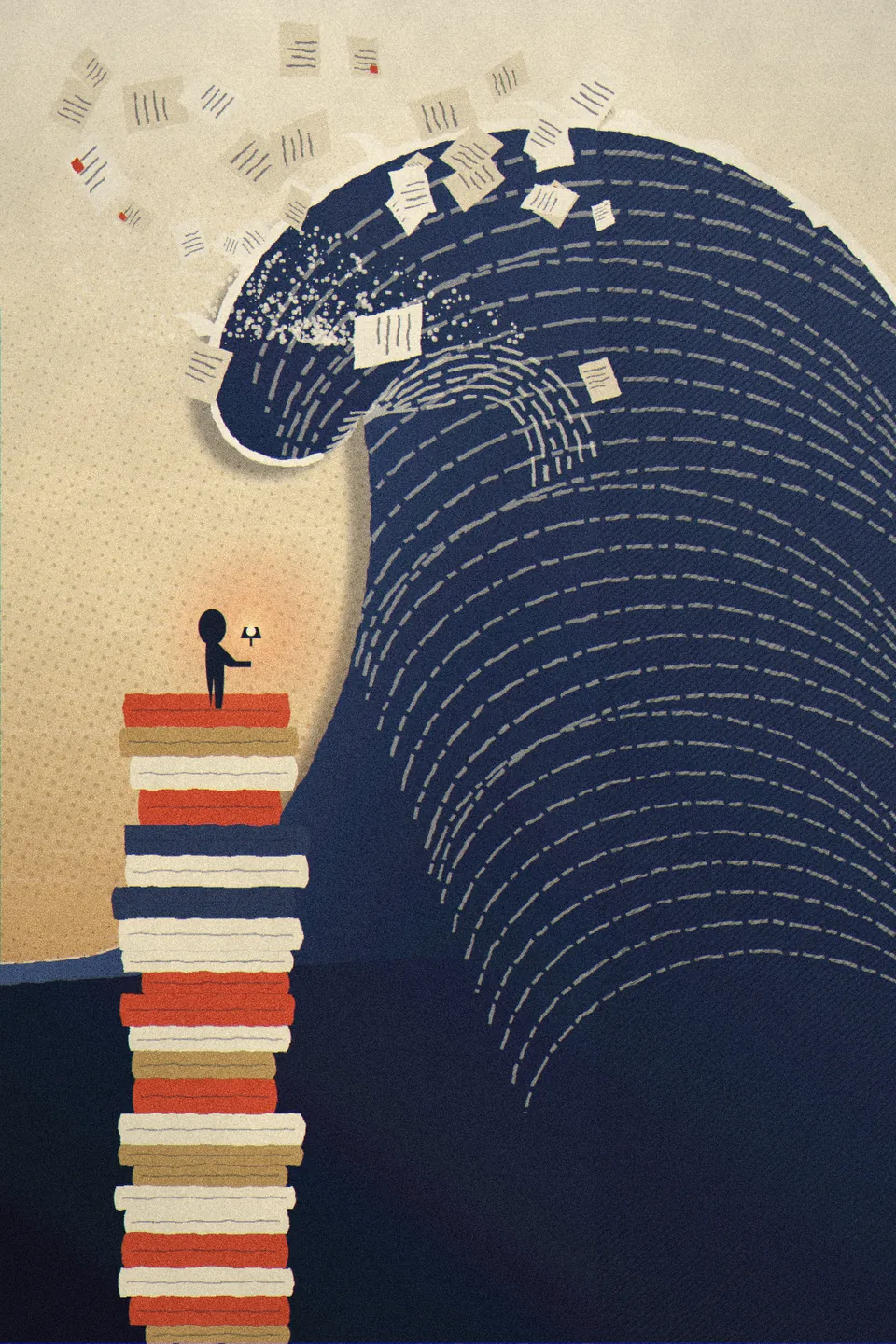
When information became abundant, the scarce thing became the ability to find, judge and trust it. And a quiet wave of inventions grew up around that need.
Books gained title pages, which told you what you were holding and who made it. Page numbers became standard, which made it possible to cite a passage precisely. Alphabetical indexes, tables of contents and catalogues spread. Scholars compiled reference works, anthologies and digests so that others did not have to read everything. Ann Blair, a historian at Harvard, has written a whole book about these early methods for managing too much to know.
Some of the most successful printers succeeded by being curators rather than mass producers. In Venice, which became the printing capital of Europe by the end of the 1400s, Aldus Manutius built a reputation by choosing carefully which texts to print, hiring scholars to edit them properly, and producing them in small, portable formats with a new, compact italic typeface. He competed on quality and trust. Readers bought his editions because his name on the page meant the text was good.
That is the second lesson of the press. In a flood, value moves to the people who filter, organise and vouch. The publisher, the editor, the reviewer, the librarian and the reference book are all, in a sense, inventions of the print era. They existed to answer one question: of all this, what should I read and can I trust it?
The scribes were not simply erased
It is tempting to tell the scribes' story as pure tragedy. The reality was messier.
For a while, printed books copied the look of manuscripts, with spaces left for hand-painted initials and decoration, so illuminators kept working on printed pages. Some scribes found work as correctors and editors in print shops, where careful reading was suddenly very valuable. Handwritten copying continued for decades in niches where it still made sense: luxury commissions, private documents, small runs.
There is also a lovely irony from 1492. A German abbot, Johannes Trithemius, wrote a treatise in praise of scribes, arguing that monks should keep copying by hand because it was good for the soul and more durable than print. To spread his argument, he had it printed.
The honest summary is that the press destroyed a particular job, transformed several others, and created entirely new ones, from typefounders and compositors to booksellers and editors. That process was painful for many individuals, and it took a long time.
A late arrival in the Islamic world
The press arrived in the Islamic world much later. The first Ottoman Turkish press run by a Muslim, Ibrahim Müteferrika, printed its first book in Istanbul in 1729, nearly three centuries after Gutenberg. Christian and Jewish communities in the empire had been printing earlier, and Arabic-script books had been printed in Europe.
Historians still debate why the delay happened. Explanations include the prestige and economic power of calligraphers and scribes, the real technical difficulty of setting a connected, flowing script in movable type, and questions of demand and patronage. The likely truth is a mix of all of them. It is worth sitting with without turning it into a simple moral, but it shows that how fast a society adopts a technology depends on far more than the technology itself.
What carries over to AI, and what does not
It is easy to force parallels between the printing press and artificial intelligence. Some of them do not hold. The press copied words that a human had written. AI generates new text, images and code, and it acts on instructions. That is a different kind of tool, and pretending otherwise is lazy.
But a few lessons do carry over honestly.
- When production gets cheap, the bottleneck moves. Gutenberg's competitors learned that printing was easy and selling was hard. The same thing is happening to writing, design and code. Making is getting cheap. Being chosen is not.
- Curation becomes the valuable work. In the print era, the people who prospered were often those who filtered, edited and vouched. In an era of infinite generated content, trusted names and careful selection matter more, not less.
- Trust needs infrastructure. Title pages, citations and named publishers were technology for knowing where a text came from. We will need equivalents for knowing where generated content comes from.
- Big shifts take longer than people expect. The deepest effects of printing played out over generations, not years. Anyone who claims to know exactly how AI will reshape society by next spring is guessing.
The patient view
If you had stood in a Mainz print shop in 1455, you would not have seen the scientific revolution, the modern newspaper or the public library. You would have seen a noisy machine, a worried financier and a man about to lose his business.
The future was inside that room. It just took a century to come out.
The press did not reward the people who printed the most. It rewarded the people who helped everyone else decide what was worth reading.
We have been here before. Not in every detail, but in the shape of it: a flood of cheap words, real losses, loud fears, and a slow, unglamorous scramble to build the tools that let people find what matters. The builders who did well last time were the ones who looked at the flood and asked what people would need in order to stay afloat.
That is still the right question.
Further reading
- The Printing Press as an Agent of Change — Elizabeth Eisenstein
- Too Much to Know — Ann Blair
- The Book in the Renaissance — Andrew Pettegree