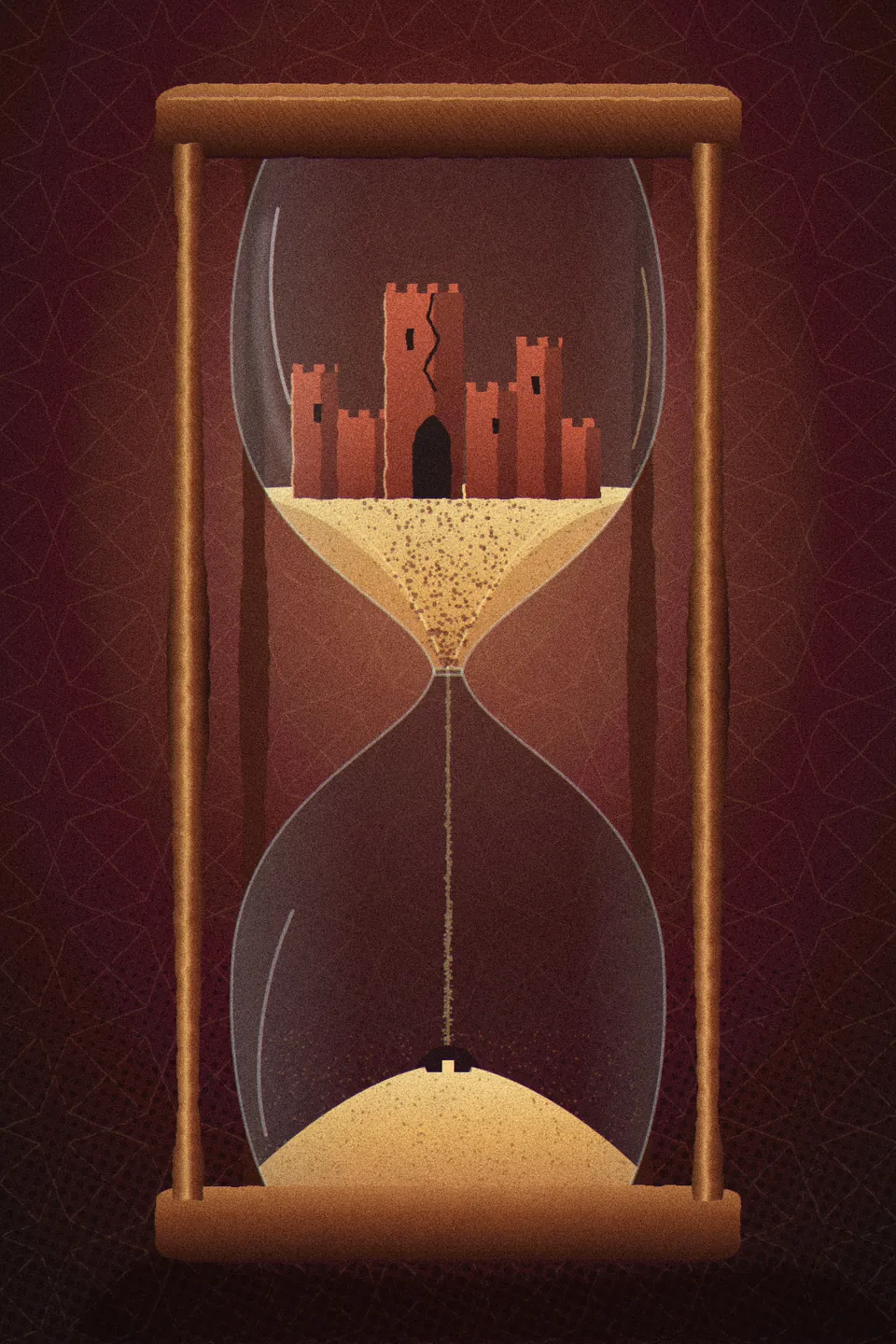
In 1375, a tired man in his forties rode away from politics and into a castle on the edge of the desert in what is now Algeria. He had served sultans in Fez, Granada, Tunis and Bijaya. He had been promoted, imprisoned, trusted, betrayed, and forced to switch sides more times than he could comfortably remember.
His name was Abd al-Rahman Ibn Khaldun. In that castle, Qal'at Ibn Salama, he spent a few quiet years writing what was meant to be an introduction to a history of the world. The introduction swallowed the book. We call it the Muqaddimah, which simply means "the introduction," and it is one of the most original works of social thought ever written.
He wanted to answer a question every ambitious person eventually asks. Why do strong things fall apart?
The force that builds empires
Ibn Khaldun had watched dynasties rise and collapse across North Africa and Andalusia his whole life. The pattern he saw was strange. Small, poor, rough groups from the desert kept conquering rich, sophisticated cities. Then, a few generations later, those conquerors became the rich, sophisticated city, and someone else rode in from the desert to replace them.
What did the outsiders have that the cities lacked? Not money. Not numbers. Not technology.
They had asabiyyah.
The word is usually translated as "group feeling" or "social cohesion," and neither quite captures it. Asabiyyah is the bond between people who have survived something together and who would, without being asked, put themselves at risk for each other. It comes from kinship at first, but Ibn Khaldun noticed it could grow from any long shared life, especially a hard one. People who depend on each other to get through a harsh winter or a long journey develop a loyalty that no salary can buy.
That loyalty is a weapon. A group with strong asabiyyah moves as one body. It does not need to be supervised. Its members do not calculate whether the next sacrifice is personally worth it. A thousand people like that can beat ten thousand who are each thinking about themselves.
The rot is built into the success
Here is the part that makes the Muqaddimah unsettling instead of merely interesting.
Ibn Khaldun argued that asabiyyah is consumed by the very victory it produces. Once the group takes the city, it gets what it fought for: wealth, safety, palaces, leisure. And comfort, slowly and politely, dissolves the bond.
He described the decline as a sequence of generations. In one famous passage he traces prestige through four of them:
- The builder, who knows exactly what it cost to create the house, because he paid that cost himself.
- The son, who worked beside the builder and learned from watching him, but learned secondhand. He understands the work, though he did not suffer through its beginning.
- The grandson, who follows tradition by imitation. He does things the way they were done without knowing why they were done that way.
- The great-grandson, who assumes the family's position is simply his by right. He looks down on the people who hold the house together, they stop feeling bound to him, and the house falls.
Ibn Khaldun suggested that a dynasty rarely lasts beyond three or four generations, which he estimated at around a century and a bit. You can quarrel with the exact number. It is hard to quarrel with the shape.
Asabiyyah is consumed by the very victory it produces.
He also noticed an economic signature of decay. Early in a dynasty, he wrote, taxes are low and revenues are high, because people keep most of what they earn and so they work hard and trade freely. Late in a dynasty, the rulers need more money to fund their luxury, so they raise taxes, and the higher rates choke the activity that paid for everything. Large assessments, small revenue. Economists still cite that passage six centuries later.
There is a line that circulates widely in the Gulf, its origin unclear, about a grandfather who rode a camel and a grandson who drives a Land Rover, and a great-grandson who may ride a camel again. People repeat it half as a joke and half as a warning. Ibn Khaldun would have recognised it instantly. It is his cycle in one sentence.
Your company is a dynasty
You do not need to rule a kingdom for any of this to apply. Every company that survives long enough lives through its own version of the four generations.
The founding team is the desert tribe. They have no money and no reputation. They work in a cramped room, they ship something broken, they fix it at two in the morning, and they learn to read each other's faces. Nobody writes down the culture because nobody needs to. They would do anything for each other because they have already done a great deal for each other.
Then the company wins. Revenue arrives. The team doubles, then doubles again. The new hires are talented, often more talented than the originals, but they joined something that already worked. They know the stories of the early days the way the son knows his father's stories: accurately, but from the outside.
Then come the imitators. A few years on, people follow processes whose original reasons have been forgotten. Meetings exist because meetings have always existed. A review step that once prevented a real disaster now just slows every release by a week, and nobody remembers the disaster.
Finally come the inheritors. These are people who treat the company's position as a fact of nature. The market share was always there. The brand was always strong. Their main job, as they see it, is to protect what exists and to make sure their own slice of it grows. They are the great-grandson in Ibn Khaldun's story, and they rarely notice that the people doing the real work have stopped feeling any bond to them.
You can see the cycle in giant firms that once seemed unbeatable and then lost to a scrappy team of a dozen. The giant usually had more money, more engineers and more data. What it no longer had was a group of people who would cross the desert for each other.
Luxury is not just money
When Ibn Khaldun talks about luxury, it is tempting to picture palaces and silk. In a company, luxury looks more ordinary.
It looks like the meeting where nobody says the product is bad because it would be awkward. It looks like a team that measures itself by headcount rather than by what it shipped. It looks like hiring people who are impressive in interviews but who have never had to build something from nothing. It looks like comfort with a slow week.
None of these feel like decay when they happen. That is the danger. Each one is reasonable on its own. Ibn Khaldun's insight was that the softening is gradual and pleasant, which is exactly why nobody resists it.
How to fight the cycle
If the cycle is natural, is it also inevitable? Ibn Khaldun was not very optimistic about dynasties. But a company has one advantage a dynasty did not. It can choose, deliberately and repeatedly, to put itself back in the desert.
A few ways builders do that:
- Keep the struggle real and shared. Offsites will not build asabiyyah. What builds it is a group facing something genuinely difficult and coming through together. A team that is always comfortable is quietly losing its cohesion.
- Tell the founding stories, then retire them. Stories help, but they are secondhand by design. The second generation needs its own hard projects, its own late nights, its own wins that belong to them.
- Kill processes when their reasons die. Every rule should be able to answer the question "what disaster does this prevent?" When it cannot, it is ritual, and ritual is how the grandson runs the house.
- Keep teams small enough to feel each other. Cohesion thins as groups grow. Small groups inside a large company can still behave like a tribe.
- Promote people who have built from nothing. Someone who has paid the full cost of creating something treats the whole enterprise differently from someone who has only maintained it.
The deepest lesson is about inheritance. You cannot hand culture down like a building. The original bond came from experiences the next generation never had. If you want them to feel it, you have to give them something of their own to fight for.
The scholar who lived his own theory
Ibn Khaldun did not write from a library tower. He wrote as a participant. He served rulers whose houses were already rotting, he watched brilliant courts turn on their own people, and late in life, as a judge in Cairo, he was in Damascus in 1401 when Timur's army besieged the city. He went out to meet the conqueror himself and later wrote about their conversations. Few historians have been that close to the machinery they studied.
That is part of why the Muqaddimah still reads as fresh. It is not a theory of what empires should do. It is a careful description of what people actually do when they win.
They relax. They forget. They begin to believe that the thing they were given is the thing they built.
The house does not fall when the enemy arrives. It falls the day the people inside stop feeling bound to each other.
Every strong team you will ever join is somewhere on Ibn Khaldun's curve. The comfort will come, because comfort is what success is for. What matters is whether you notice the bond thinning while there is still time to go back out into the desert and earn it again.
Further reading
- The Muqaddimah — Ibn Khaldun, translated by Franz Rosenthal
- Ibn Khaldun: An Intellectual Biography — Robert Irwin
- War and Peace and War — Peter Turchin