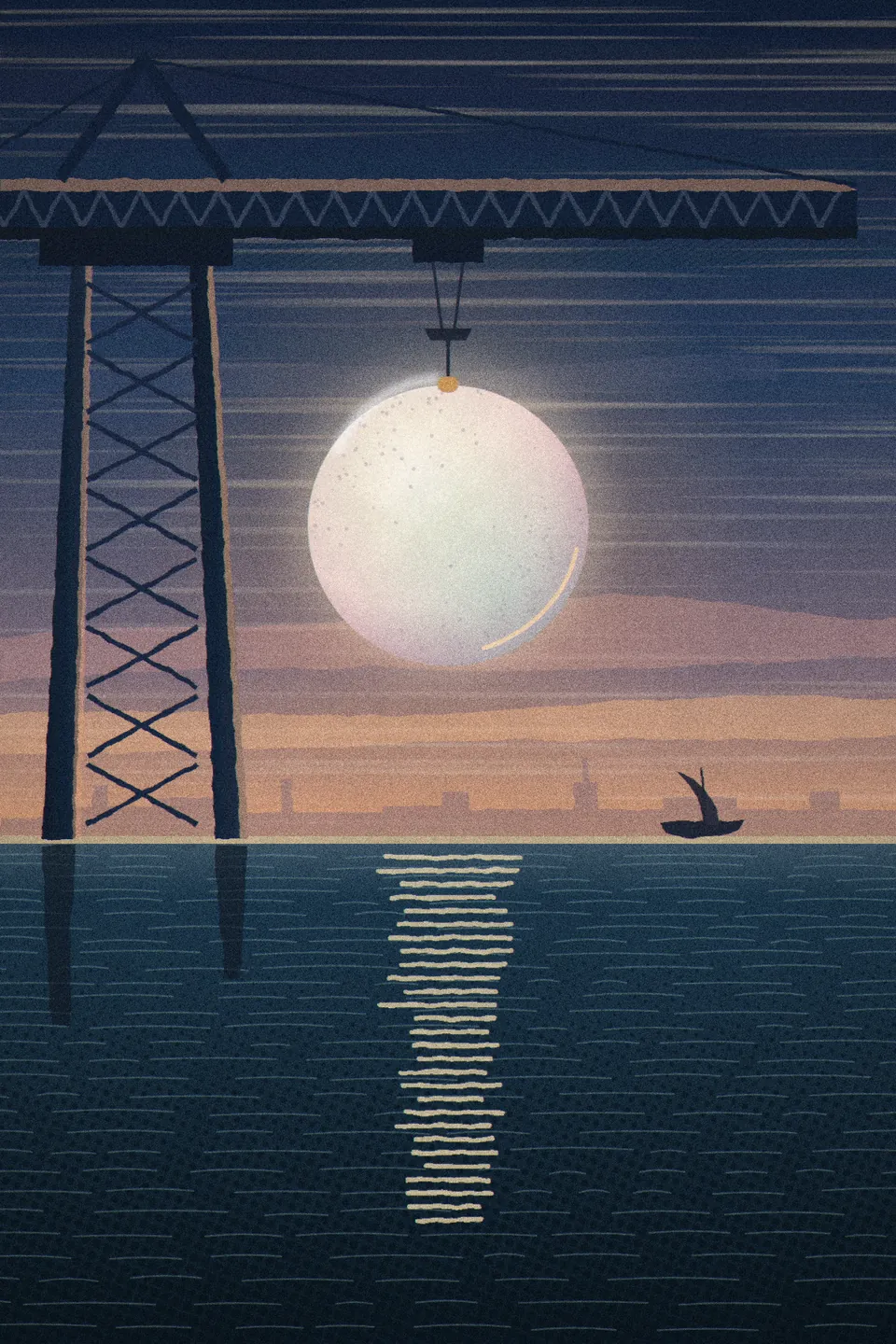
For hundreds of years, the most valuable thing in Dubai was at the bottom of the sea.
Every summer, during the season the divers called the ghaus, wooden boats left the Creek and headed out to the oyster beds of the Gulf. Men went down on a single breath, a stone tied to their feet to sink them fast, a clip pinching their nose, a basket at their waist. A puller on deck held the rope and hauled them up when they tugged. They did this dozens of times a day, for months, in water warm enough to drain anyone. At night the oysters were opened, and most of them held nothing.
Gulf pearls were among the finest in the world. They went to Bombay, and from there to the jewellers of Europe and the courts of India. The whole coast was organised around them: the boats, the merchants who financed the boats, the debts that tied divers to captains for years, the season that set the rhythm of the year.
Then, within a single generation, it was gone.
The collapse nobody on the boats could see coming
Two things happened far away from the Gulf, and neither had anything to do with how hard anyone worked.
The first was in Japan. In the early twentieth century, Kokichi Mikimoto and others perfected a way to make oysters grow pearls on purpose, by placing a small nucleus inside the shell and farming the oysters in calm water. By the 1920s, cultured pearls were reaching world markets in large numbers. They looked, to most buyers, like the real thing. They cost a fraction of the price.
The second was the Great Depression. After 1929, the rich people who bought natural pearls stopped buying luxuries at all.
Squeezed from both sides, the pearling economy of the Gulf fell apart through the 1930s. Boats stayed on shore. Merchants went bankrupt. Families who had dived for generations had nothing to sell. Older Emiratis still talk about those years as a time of real hardship.
The divers did nothing wrong. The world simply stopped needing the thing they were best at.
If you build anything, sit with that for a moment. The pearl divers were skilled, brave, and organised. Their product was genuinely excellent. None of that mattered once a cheaper substitute arrived and the customers ran out of money at the same time. It is the oldest story in technology, told centuries before anyone used the word.
A town that was already a bet
Dubai had one advantage going in. It was already a place that thought of itself as a trading post rather than just a pearling village.
Around the turn of the twentieth century, Dubai's ruler made the town friendly to merchants, lowering the taxes and duties that other ports charged. Traders from the Persian coast, especially from the port of Lingeh, moved across the water and settled along the Creek. They brought their networks, their capital, and their habits of trade with India and East Africa. The neighbourhood that grew around them, with its wind towers, still stands.
So when pearls died, the instinct was already there: if we cannot dig wealth out of the sea, we can make money from the goods that pass through.
The problem was the Creek itself.
Dredging the Creek
Dubai Creek is a natural inlet that cuts into the land and divides the old city in two. It was the whole reason the town existed. But by the 1950s it was silting up. Sandbars blocked the mouth, and larger vessels could not get in safely. Cargo had to be moved off ships onto small boats in open water. A trading town whose harbour is closing is a town with a clock on it.
Sheikh Rashid bin Saeed Al Maktoum, who would become ruler in 1958, decided to dredge it. Dubai did not have oil money then. It did not have much money at all. The project was paid for largely with borrowed funds, including a loan from Kuwait, repaid through the trade the deeper Creek brought in.
Think about the shape of that decision. A small town with almost no revenue borrows heavily to fix its harbour, on the theory that if ships can come, they will. There is no market research that proves this in advance. There is only the bet.
It worked. Ships came. Trade grew. Dubai became a busy re-export hub, moving goods in and out to the wider region. The Creek, lined with wooden dhows unloading everything from rice to electronics, became the image the city still uses for itself.
The oil that was never going to be enough
In 1966, oil was found offshore at the Fateh field. Exports began a few years later.
This is the moment where the story could have gone the familiar way, where a small state discovers oil and organises everything around it. Dubai did something more interesting. Compared with Abu Dhabi, its neighbour and the anchor of the federation formed in 1971, Dubai's reserves were modest. Its leaders seem to have understood early that the oil would not last, and that its real use was as a bridge.
So oil revenue went into more infrastructure. Port Rashid opened in 1972. Dry docks followed. The Dubai World Trade Centre tower went up in 1979, at the time the tallest building in the region, standing in what was then mostly empty land well outside the centre of town. People wondered why anyone would build it out there.
Today the city has grown all the way around it, and far beyond. Oil is a small fraction of Dubai's economy now. The bridge did its job.
Jebel Ali, or how to look foolish on purpose
The boldest bet came next.
In the late 1970s, Dubai built a new port at Jebel Ali, on the coast well south of the city. It was huge: an artificial harbour cut out of the desert, with dozens of berths, at a time when Port Rashid was not obviously struggling. The story told about it is that critics thought it far too big for any realistic demand.
Jebel Ali opened in 1979. In 1985, the land around it became the Jebel Ali Free Zone, where foreign companies could set up with full ownership and no customs duties on goods passing through. Companies came, then more companies. Over the following decades, Jebel Ali grew into one of the busiest container ports in the world and the largest in the Middle East.
Infrastructure looks oversized on the day it opens and obvious ten years later.
The thing to notice is the order of events. The port came first. The free zone came next, giving businesses a reason to use it. The demand arrived afterward and grew into the space that had been made for it. If Dubai had waited until the existing port was overflowing, it would have spent years losing business to neighbours while the new one was built.
An airline with two borrowed planes
The same logic went into the sky.
In 1985, the same year as the free zone, Dubai launched Emirates. It started very small: two aircraft leased from Pakistan International Airlines, a modest sum of start-up money from the government, and a first route to Karachi. The airline was expected to stand on its own commercially rather than live on subsidies.
At the time, a national carrier for a city-state of Dubai's size seemed like an odd vanity. But Dubai sits within a few hours' flight of a huge share of the world's population, across Europe, Africa, the Indian subcontinent and Asia. Emirates turned that geography into a business: fly people into Dubai, and send them on anywhere. The airport grew with it, until Dubai International became the busiest airport in the world for international passengers.
A port moves boxes. An airline and an airport move people, and people bring money, ideas, and companies. Once the planes were landing, the city had a reason for tourism, conferences, finance and everything else that followed.
What the pattern actually is
It is tempting to tell Dubai's story as one of vision, and leave it there. That is too vague to be useful. The pattern is more specific, and you can steal it.
- Lose the illusion that your current product is safe. Pearling taught the region that a good business can disappear for reasons entirely outside your control. Everything afterward was built with that memory.
- Bet on the layer underneath. Dubai never tried to make the best product. It made the place where products moved: harbours, ports, free zones, runways. Platforms outlive the things that pass through them.
- Build before the demand is visible. The Creek, the World Trade Centre, Jebel Ali and Emirates all looked early or oversized. Each one created the demand it was built for.
- Use temporary wealth to buy permanent position. Oil was treated as a bridge to cross, not a home to live in.
- Accept looking foolish for a while. Every one of these bets had critics, and the critics were reasonable given what anyone could see at the time.
This is also how good technical foundations work. When you build a company, the temptation is to build only what today's users are asking for. Sometimes that is right. But the decisions that matter most, the ones that set your ceiling for years, are usually about capacity you do not yet need: the architecture that can handle a hundred times the load, the market you are positioned for before it exists, the team you hire ahead of the work.
The risk is real. Not every big port fills up. Plenty of places around the world built huge things that stayed empty. Building ahead of demand only works when you have a clear reason to believe the demand is coming, and the patience to wait for it. Dubai's reason was geography, a long memory of trade, and leaders who kept compounding one bet on top of the last.
The pearl and the port
In Dubai's museums you can still see the tools of the pearl trade: the nose clips, the weights, the merchants' little scales and the cloth bags for the pearls. They look tiny. Everything about that economy was small, careful and close to the body. Wealth was something you held in your palm.
A few kilometres away, cranes at Jebel Ali lift containers the size of houses off ships longer than the old town was wide.
The distance between those two objects is less than a century. It was not crossed by finding a better pearl. It was crossed by people who stopped looking for treasure on the sea floor and started building the place where the world's treasure would have to pass.
Further reading
- City of Gold: Dubai and the Dream of Capitalism — Jim Krane
- Dubai: The Vulnerability of Success — Christopher M. Davidson