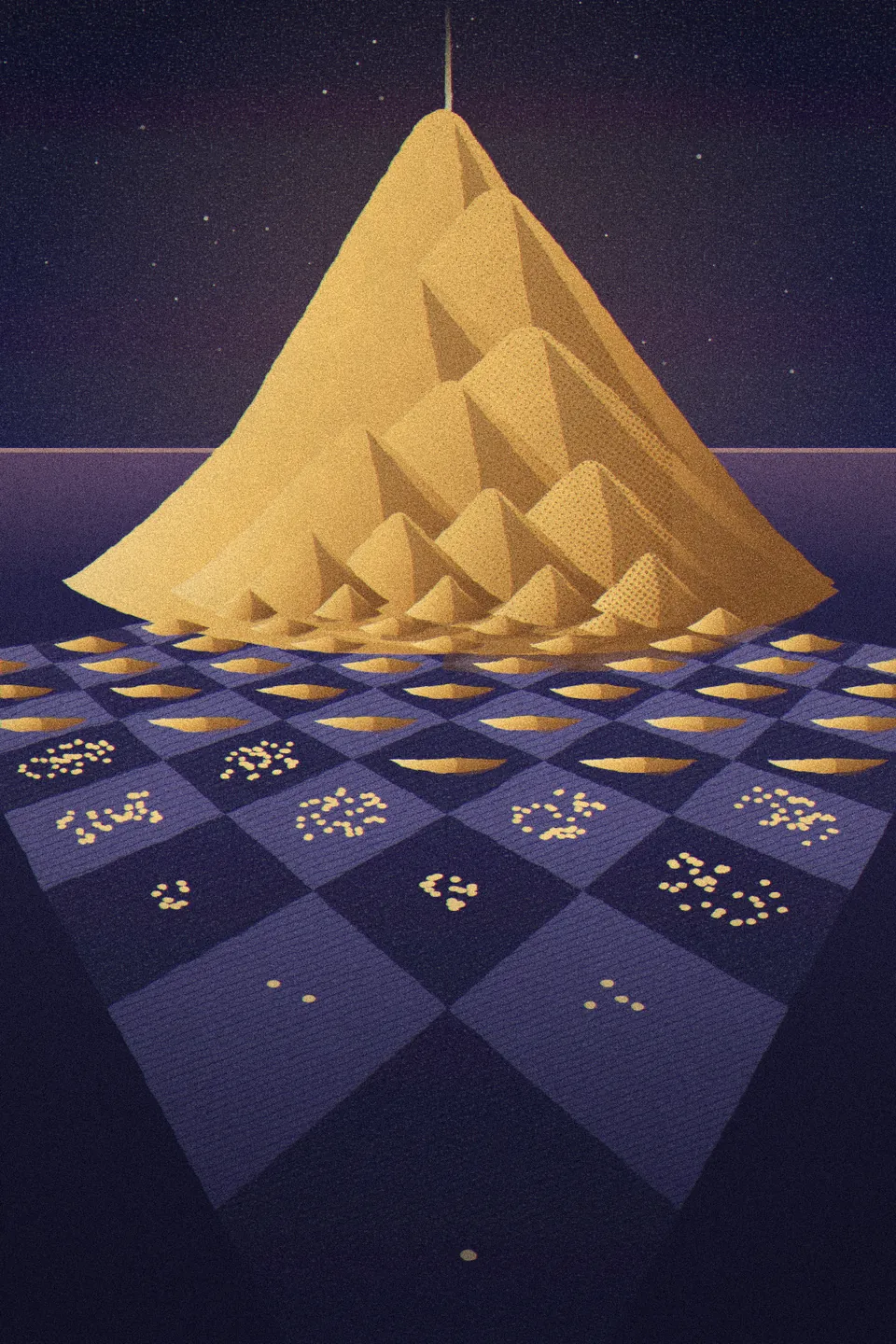
There is an old story about the inventor of chess.
A king, delighted by the game, offers the inventor any reward he likes. The inventor asks for something that sounds almost insulting: one grain of wheat on the first square of the board, two on the second, four on the third, doubling every square until all sixty-four are filled. The king laughs and agrees.
By the end of the first row, the inventor has 128 grains. You could hold them in one hand. Halfway across the board, the numbers start to get strange. By the last square, the total is more wheat than the entire world now grows in a thousand years.
The story is a legend, and versions of it have been told in India, Persia and the Arab world for a very long time. It survives because it captures something the human brain is very bad at feeling: the first half of an exponential curve looks like nothing at all.
The shape that fools you
Most of us think in straight lines. If you put in a little work, you expect a little result. Put in twice the work, get twice the result. That intuition is fine for most of daily life, which is why we have it.
Compounding breaks it. When each gain is built on top of the previous gains, the growth is slow and then sudden. Nearly all of the visible result arrives at the end.
Here is the cleanest version of the arithmetic. If you get 1% better at something every day for a year, you end up roughly 37 times better, not 365% better, because 1.01 multiplied by itself 365 times is about 37.8. If you get 1% worse every day, you end up with less than 3% of what you started with.
Those numbers are a toy. Nobody improves by exactly 1% a day. But the toy shows the shape, and the shape is the lesson. Two lines that start almost on top of each other end up in different universes.
The first half of an exponential curve looks exactly like failure.
Money is just the famous example
People usually learn about compounding through money, and the go-to example is Warren Buffett. He started investing as a child and never really stopped, and the overwhelming majority of his fortune arrived after his sixties. He was a good investor, but the real trick was that he was a good investor for over seventy years without interruption. Time did most of the work.
You may have seen a quote calling compound interest the eighth wonder of the world, usually credited to Einstein. There is no good evidence he said it. The fact that it gets attributed to him anyway tells you how badly people want this idea to have a genius behind it. It does not need one. It is just arithmetic, applied patiently.
The more useful realisation is that money is only one of many things that compound. Anything compounds when what you have makes it easier to get more of it.
Skills
Knowledge compounds because new ideas attach to old ones. The first book you read on a subject is hard, because you have nothing to hang it on. The tenth is easy, because you already have the scaffolding, and you start noticing what the authors disagree about, which is where the real learning lives.
This is why the gap between people who keep learning and people who stop gets wider every year. It is not that one group is smarter. It is that one group has a bigger surface for new knowledge to stick to. Programming works this way. So do languages, mathematics, design and writing. The person who has written every week for five years does not write five times better than the person who wrote for one. They often write in a different way entirely.
Reputation
Reputation compounds because trust lets you do things that earn more trust.
Someone who delivers what they promised gets a slightly bigger task next time. Delivering that earns a bigger one. After enough rounds, people bring them opportunities without being asked, and introduce them to others, who start the cycle with a head start. From the outside, this looks like luck or charm. From the inside, it is a long series of small promises kept.
The Gulf has always understood this. Old merchant families traded for generations on a name, and a family's word could carry a deal across the sea. A name like that is not built in a year. It is the accumulated weight of thousands of honest transactions, each one adding a little.
It also breaks in an afternoon. That asymmetry is part of the math too.
Relationships
Naval Ravikant has a line that has stuck with a lot of people: play long-term games with long-term people. The point is that relationships compound only if they continue.
A friend you have known for fifteen years can tell you something in one sentence that a stranger would need an hour to explain, because you share the context. Collaborators who have worked together for years move faster than any new team, because they have already had all the arguments. The returns on a relationship come from its length, which is why you should be careful about people who are always starting over.
Health
Your body might be the clearest example of all, partly because it runs in both directions.
Strength, fitness and sleep build on themselves. A body that moves regularly can do more, which makes moving easier, which makes it more likely you will keep doing it. The reverse is just as real. A few years of poor sleep and no movement do not announce themselves day by day. They arrive later, all at once, as a body that feels much older than it is.
This is the cruel part of the quiet exponent. The costs are invisible on any single day. Skipping one workout changes nothing. Eating badly once changes nothing. One late night scrolling changes nothing. The bill for all of them arrives together.
Compounding does not care whether you are building something or wearing it down.
Why people quit right before it works
If compounding is so powerful, why doesn't everyone use it?
Because the feedback is terrible. For the first long stretch, effort produces almost no visible result. You go to the gym for a month and look the same. You write for a year and nobody reads it. You learn for months and still feel like a beginner. Every signal your brain receives says this is not working.
Meanwhile, the rewards of quitting are immediate. You get your evening back. You stop feeling behind. The cost of quitting, all that future growth that will now never happen, is invisible, because it never happens.
So most people quit in the flat part of the curve, which is the only part they ever experience. They conclude, reasonably, that the thing does not work.
The people who seem to have strange, outsized results in their thirties and forties are often just the ones who stayed in long enough to reach the steep part.
The rules, such as they are
You cannot force compounding to go faster. You can only set up the conditions and get out of the way. A few rules help.
- Never interrupt it unnecessarily. The single biggest destroyer of compounding is a reset. Stop for two years and start again, and the cost is far more than two years: you lose much of what you had built, plus the time to rebuild it. Doing a small amount consistently beats doing a lot occasionally.
- Choose what to compound with care. You will compound something whether you choose or not, because you repeat things every day. Look at what you repeat and ask where it leads in ten years.
- Protect against ruin. Compounding only works if you survive. One catastrophic loss, of health, of money, of trust, can wipe out decades. Avoid the bets that can end the game.
- Measure in years, not weeks. If you judge a habit by how you feel this week, you will quit everything worthwhile. Judge it by where it puts you in five years.
- Make it small enough to keep. A habit you can sustain on your worst day beats an ambitious one you abandon in a month.
None of this is exciting. That is part of why it works. The exciting things are the ones everyone is already chasing.
The quiet years
When you are young, everything around you is designed to reward speed. Apps measure success in seconds. Feeds show you people who seem to have made it overnight. It is easy to believe that results should be quick, and that if they are not, you are doing something wrong.
But most of the things worth having are on the slow curve. A deep skill. A good name. Friends who have known you for decades. A body that still works when you are old. Each of them is built in the quiet years, in work nobody notices, including you.
The wheat on the chessboard does not change when the king starts to worry. It doubles the same way on the third square as on the sixty-third. The only difference is that on the sixty-third, everyone can finally see it.
Your job is to keep placing grains while the board still looks empty.
Further reading
- The Psychology of Money — Morgan Housel
- Atomic Habits — James Clear
- The Almanack of Naval Ravikant — Eric Jorgenson